
What the changing employment law landscape, and the rise of AI-assisted preparation, mean for how employees defend themselves at work.
Shakil Dixon, Founder and Principal Representative | Zhan Associates | 12 September 2026
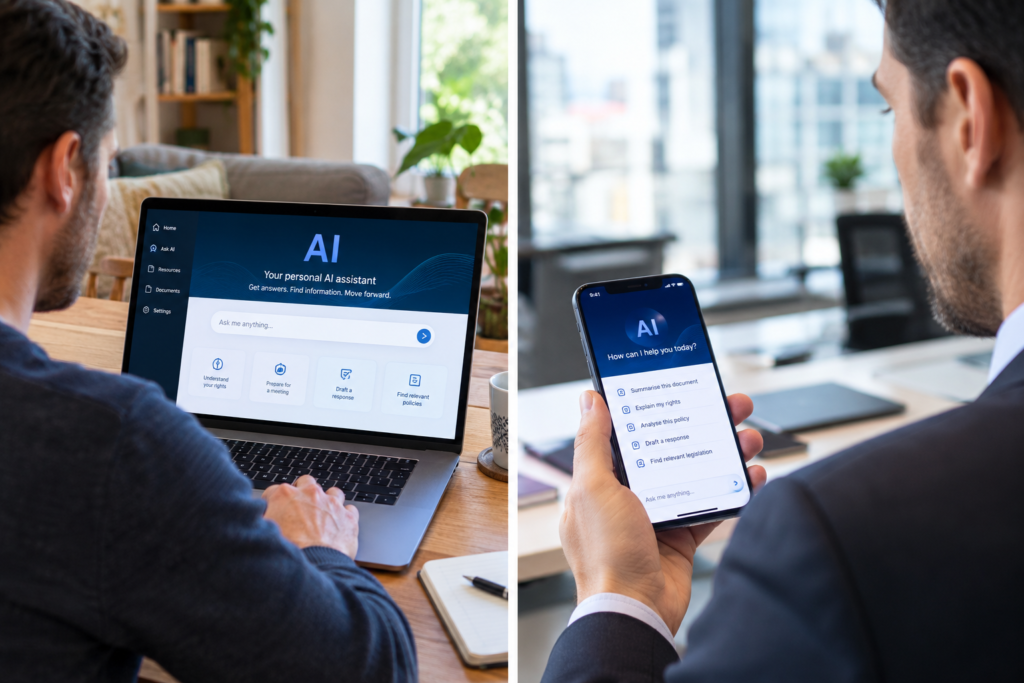
An employee facing a disciplinary allegation today has access to something no previous generation of employees has had: an artificial intelligence system at their fingertips that can explain a policy, summarise a letter, draft a grievance, or suggest questions for a hearing, within seconds and at no cost.
That is a genuine development, and it deserves to be taken seriously rather than dismissed.
It also raises a specific question, and this piece sets out to answer it plainly: does wider access to information reduce an employee’s need for representation at a disciplinary hearing, grievance, appeal or tribunal claim?
The answer is no. The reasoning is worth setting out in full, because the reasons matter more than the conclusion.
The regulatory landscape is genuinely changing
The changes are not marketing colour. They are commenced or imminent, and a representative advising on any live matter needs to hold the correct date for each.
From 1 October 2026, the time limit for bringing most employment tribunal claims extends from three months to six. This is now settled: the implementing regulations have been approved by both Houses of Parliament and take effect on that date. The extended limit applies where the relevant act, or the last in a series of acts, falls on or after 1 October 2026. A claim arising entirely before that date remains subject to the current three-month limit. The requirement to notify ACAS and complete Early Conciliation before issuing a claim is unchanged, and conciliation continues to pause the clock.
From 30 October 2026, employers face a strengthened duty to take all reasonable steps, not merely reasonable steps, to prevent sexual harassment of their workers, together with third-party harassment liability and expanded trade union access and information duties. This is a separate date and a separate set of obligations from the time limit change three to four weeks earlier. Treating the two as one event, as some early commentary did, is a mistake worth correcting.
From 1 January 2027, the qualifying period for ordinary unfair dismissal falls from two years to six months, and the statutory cap on the compensatory award is removed. The commencement regulations confirm that any employee with six months’ continuous service on that date gains protection immediately. In practice, that means anyone continuously employed from on or before 1 July 2026 will hold protection from the first day of January 2027, regardless of how long they have actually served.
None of this makes unfair dismissal a day-one right. It was not proposed as one in the final legislation, and it should not be described that way. The day-one entitlements that took effect earlier in 2026, statutory sick pay, paternity leave and unpaid parental leave, are a distinct set of changes and should not be conflated with the qualifying period reform.
A further point deserves emphasis because it is the one most likely to be missed. Acas is separately consulting, until 23 September 2026, on a fully revised Code of Practice on disciplinary and grievance procedures. The current Code, in force since 11 March 2015, runs to forty-seven paragraphs. The draft under consultation runs to ninety-five, very nearly double, and proposes a marked shift toward informal resolution before any formal process begins. Acas is also asking whether the Code’s title should change to reflect that widened scope. None of this is in force. It is a draft, and any representative citing the Code in a live matter must state, and should be prepared to be asked, which version is being relied upon. Citing the draft as though it carries current authority is an error that an experienced HR adviser or an opposing representative will notice immediately, and it is not one this practice will make.
What AI can genuinely do for an employee, and where that help stops
An employee who receives a disciplinary letter can now put it into an AI system and ask what it means, what the possible outcomes are, what questions to prepare, or where a chronology of events becomes inconsistent. Used well, that is a legitimate and useful first step. It can turn confusion into a structured set of questions before the employee speaks to anyone else.
It is also, on its own, an incomplete defence, for reasons that have nothing to do with the technology’s competence and everything to do with the nature of a disciplinary hearing.
An AI system can identify ten points that might be raised. Deciding which three actually carry weight, and which seven would dilute the argument or invite an unnecessary challenge, is a judgment call made by someone who has sat across from an investigating manager before and has some sense of how the room will respond. An AI system can flag an inconsistency between two documents. Whether that inconsistency is material, and how it should be put to the panel, depends on the rest of the evidence and on how the meeting is actually unfolding at the moment it is raised. A hearing is a live process: a witness answers differently than expected, a manager concedes a point, a document takes on a different meaning once another is discussed. A defence has to adapt to that in real time, and a document prepared in advance, however well drafted, does not do that by itself.
There is also a narrower and more practical caution. AI systems can misstate the law, apply an outdated commencement date, misread a policy, or produce a confident-sounding argument with little legal substance. The judiciary and the Solicitors Regulation Authority have both raised concerns about exactly this, including the risk of fabricated or misattributed authorities appearing in AI-generated material. An employee who treats an AI-generated argument as settled, without it being tested by someone who knows what a tribunal or a disciplinary panel actually needs to see, is taking on a risk they may not recognise as a risk.
The distinction, stated plainly, is this: AI can help an employee prepare. It does not represent them. Preparation and advocacy are different disciplines, and conflating them is the most common mistake an unrepresented employee makes.
The employer’s side has not stood still
It would be a mistake to treat this only as an opportunity for employees. Employers, too, increasingly draw on HR systems, document management tools, and their own legal and consultancy advice. An employer entering a disciplinary process typically has an investigator, an HR function, a documented policy framework, and often an external adviser, behind the manager sitting across the table.
That asymmetry is not new. What is new is that both sides now have better tools for building their case. An employee with an AI-assisted chronology and a well-prepared line of questioning is in a materially stronger position than one who is not. But better preparation on the employee’s side does not close the gap in institutional experience and resource that the employer typically brings to the room. Representation exists to address exactly that gap.
The tribunal caseload is rising, and that changes the stakes of getting it wrong early
Employment tribunals are under sustained pressure. The Ministry of Justice’s published statistics record an open single-case caseload of 64,000 at the end of March 2026, rising to 70,000 by the end of June 2026, both figures the highest in the published time series. Receipts have continued to outpace disposals through the year.
That pressure is relevant to a workplace defence practice for a specific reason, not a general one. It means that a claim, once issued, is likely to take longer to resolve, that evidence needs to be preserved and organised properly from the outset rather than reconstructed months later, and that the quality of the internal process, the investigation, the hearing, the appeal, matters more, not less, because it may be the clearest evidence a tribunal sees of how the matter was actually handled.
It also means that an employee should not treat a longer limitation period as room to delay. Evidence does not improve with age. Witnesses move on, memories become less precise, and documents become harder to locate. The extension of the time limit to six months provides more time to prepare a claim properly. It is not a reason to leave that preparation until later.
What a properly prepared defence actually requires
A disciplinary allegation, a grievance, or a tribunal claim rarely turns on a single fact. It usually turns on a chain of process questions: how the allegation was investigated, whether the employee had a genuine opportunity to respond, whether the evidence relied upon was tested, whether the sanction was proportionate to what was actually established, and whether the appeal reconsidered the decision rather than rubber-stamping it.
A sound defence works through those questions systematically. What exactly is alleged. What evidence supports it. What is genuinely disputed. What evidence, if any, points the other way. What has not been obtained that should have been. What context explains the conduct, if the conduct is accepted. And, even where an allegation is made out, whether it justifies the sanction proposed.
AI tools can help organise that material. Structuring the chronology, flagging inconsistencies across a large set of documents, or drafting a first pass at a written response are all tasks where AI assistance genuinely speeds up preparation. What it does not replace is the judgment that decides which three points actually matter to the panel in front of you, how to raise a procedural defect without letting it overshadow the substantive defence, and how to read and respond to what is actually said in the room.
Why representation is not the same as confrontation
There is a common assumption that having a representative present means the meeting becomes adversarial. It should not, and in a well-run hearing it does not.
Effective representation at a disciplinary or grievance hearing is not about volume. It is a calm, evidence-based case, put clearly: that a particular allegation is not supported by the document relied upon, that contradictory evidence exists and has not been addressed, or that the decision-maker should consider a specific piece of context before reaching a conclusion. That is disciplined advocacy within the statutory role, not confrontation, and it is the register this practice works in.
It is also worth stating precisely what that role permits, because the statutory position is narrower than some employees expect. A companion attending under Section 10 of the Employment Relations Act 1999 may address the hearing to put the worker’s case, sum it up, respond on the worker’s behalf to points raised, and confer with the worker during the meeting. The companion may not answer questions put directly to the employee, and setting that expectation correctly at the outset avoids a difficult moment in the room later.
What this means in practice
The right approach for an employee facing a disciplinary process is not to choose between AI and representation. It is to use each for what it does well.
AI can help with early orientation: understanding a letter, identifying relevant policies, organising a chronology, and preparing an initial set of questions. That is genuinely useful, and an employee who arrives at a first consultation having already done some of that thinking is in a stronger starting position than one who has not.
What follows that stage is judgment: which points to raise, how to raise them, what the evidence actually establishes once tested, and how to respond to a hearing that does not go exactly as anticipated. That is where a representative’s experience of the process, rather than knowledge of the rules alone, carries the weight.
The employee who combines both, informed preparation and experienced representation, is in a materially stronger position than one relying on either alone. Understanding the rules and knowing how to apply them in a live hearing are two different skills, and a disciplinary process rarely allows for a second attempt at getting either one right.
This article is for general information only. It does not constitute legal advice and should not be treated as a substitute for advice on the specific circumstances of an individual matter. Zhan Associates is not a law firm and does not carry out reserved legal activities within the meaning of the Legal Services Act 2007. Representation at workplace hearings is provided under the statutory right to be accompanied, Section 10 of the Employment Relations Act 1999.
Sources: Acas; GOV.UK Tribunal Statistics Quarterly (January to March 2026 and April to June 2026); the Employment Rights Act 2025 (Commencement No 4 and Transitional and Saving Provisions) Regulations 2026; the draft Employment Tribunal (Extension of Time Limits) (Miscellaneous Amendments and Transitional Provisions) Regulations 2026; the Acas consultation on the draft Code of Practice on disciplinary and grievance procedures, opened 30 July 2026 and closing 23 September 2026; the Courts and Tribunals Judiciary; the Solicitors Regulation Authority. Position stated as at 12 September 2026. The proposed Acas Code remains a draft and is not in force.
About the Author
Shakil Dixon is the Founder and Principal Representative at Zhan Associates, specialising in workplace advocacy, disciplinary representation, appeals and strategic defence for employees facing significant employment disputes. With more than three decades of experience in workplace representation, public service and organisational governance, he advises clients on achieving procedurally fair outcomes while ensuring employers remain accountable to both the law and the principles of natural justice.